Beltane: The Firelit Threshold Into Summer
Explore the ancient fire festival of Beltane, from its Gaelic roots and protective bonfire customs to its modern celebration as a season of passion, fertility, abundance, and renewal. This blog traces Beltane through May Day traditions, flower crowns, the Maypole, sacred union, folklore, and the living magic of summer’s arrival.
Jackie Taylor
5/1/20268 min read
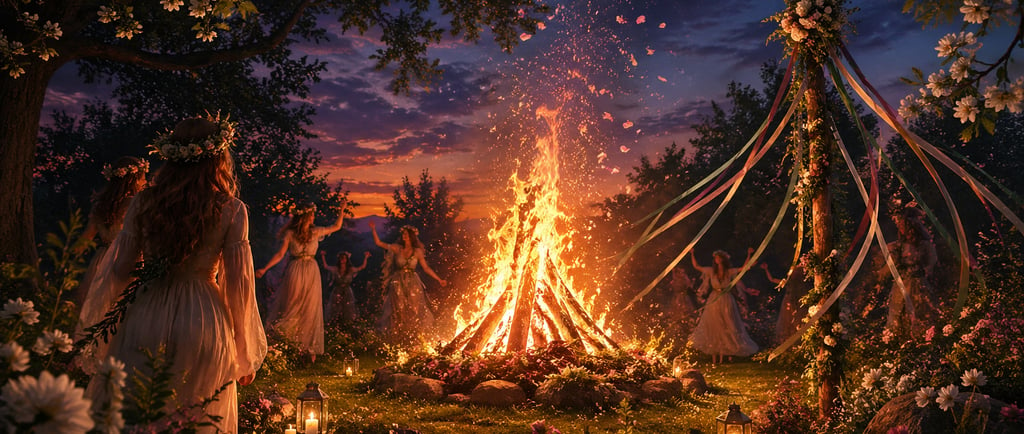
As May approaches, many people begin thinking about May Day. They picture young women dancing around the maypole, flower crowns woven from spring blossoms, and the crowning of the May Queen. Others think of Catholic May devotions to the Blessed Virgin Mary, where Mary is honored with flowers and crowned as the Queen of Heaven.
But beneath these familiar images is an older current.
Long before May Day became a softened celebration of spring, Beltane burned at the threshold of the bright half of the year. Known in Irish as Bealtaine, this ancient Gaelic festival was traditionally celebrated from the evening of April 30 into May 1. It marked the beginning of summer in Ireland, Scotland, and the Isle of Man, when the land grew green, the cattle were moved to summer pasture, and the whole world seemed to stir with heat, desire, and life.
Beltane is a festival of fire, fertility, protection, abundance, passion, and awakening. It is the moment when spring no longer whispers. It rises.
The Roots of Beltane
Beltane comes from the Gaelic-speaking Celtic world, especially Ireland, Scotland, and the Isle of Man. It was one of the four great Gaelic seasonal festivals, along with Samhain, Imbolc, and Lughnasadh. These festivals helped divide the agricultural and pastoral year, marking the turning points that mattered most to the lives of the people.
Beltane stood opposite Samhain. Samhain opened the dark half of the year, when winter, death, ancestors, and shadow came close. Beltane opened the bright half, when warmth, growth, fertility, and outward life returned.
In older Irish tradition, Beltane was sometimes associated with the beginning of summer. This may feel strange to modern readers who think of May as late spring, but in the older seasonal rhythm, May was the doorway into summer’s power. The land was blooming, the animals were fertile, milk and butter were returning, and the people prepared for the abundance and risks of the warm season.
The name Beltane is often connected with fire. Some interpret it as “bright fire” or “lucky fire,” which fits the heart of the festival beautifully. Others have linked the name to a figure called Bel or Belenus, sometimes described in modern Pagan writing as a Celtic fire or solar god. That connection is popular, but historically uncertain. What we can say with more confidence is that Beltane has always carried the mark of flame.
The fire is the key.
Why Beltane Was Celebrated
Beltane was not simply a pretty spring festival. It was a sacred act of survival.
For pastoral communities, cattle were wealth, food, status, and security. Around Beltane, herds were moved to summer grazing lands. This was a vulnerable time. Disease, injury, bad weather, theft, poor milk production, and unseen spiritual forces could threaten the household’s prosperity.
So the people lit fires.
Cattle were driven between two flames or through the smoke of sacred fires for purification and protection. Hearth fires might be extinguished and rekindled from the communal Beltane flame. People gathered around fire not only to celebrate, but to bless the season ahead.
The fire protected the herd.
The fire protected the home.
The fire protected the body.
The fire called summer in.
Beltane was a festival of fertility, but fertility meant more than sex. It meant the grass growing thick. It meant cattle thriving. It meant milk flowing, butter forming, flowers blooming, seeds strengthening, bodies awakening, and the household being held in abundance.
It was life-force in every form.
Fire, Passion, and Protection
The Beltane fire is one of the most powerful symbols of the old festival. It is both sensual and sacred, both practical and magical.
Fire purifies. Fire transforms. Fire consumes what is stagnant and awakens what is sleeping. At Beltane, fire becomes the living symbol of summer’s arrival.
In modern Pagan practice, the Beltane fire is often seen as the flame of passion, sexual energy, love, creativity, and sacred embodiment. It is the spark between lovers, the heat in the blood, the courage to desire, and the wildness of life returning after winter’s restraint.
Historically, the fire was also deeply protective. It guarded cattle and people from illness, misfortune, harmful magic, and interference from the Otherworld. Like Samhain, Beltane was considered a liminal time, a threshold when the veil between the human world and the spirit world grew thin. The Good People, the fair folk, the unseen ones, were close.
This is one of the reasons Beltane has such a charged feeling. It is joyful, yes, but not careless. It is a night of beauty, heat, and watchfulness. The world is alive, and not all that lives is tame.
Flowers, Greenery, and the May Bush
If Samhain belongs to bone, smoke, root, and shadow, Beltane belongs to blossom, branch, flame, and milk.
Flowers and greenery were central to Beltane customs. Homes, doors, windows, barns, cattle, and dairy tools were decorated with protective plants and bright seasonal flowers. Yellow and white blossoms were especially common, including primrose, gorse, hawthorn, rowan, and marsh marigold.
These flowers were not merely decorative. They were charms of protection and blessing. They marked the home as guarded. They welcomed abundance. They mirrored the brightness of the fire and the flowering of the land.
One important Irish custom was the May Bush, a small tree, branch, or thorn bough decorated with flowers, ribbons, shells, eggshells, and other bright offerings. The May Bush stood as a sign of summer’s arrival and the household’s participation in the seasonal blessing.
Hawthorn especially carries deep magical weight. It is beautiful, thorned, fragrant, and dangerous. In Irish folklore, hawthorn is often connected with the Otherworld and the fair folk. To bring its blossoms into ritual space is to touch something old, fragrant, and not entirely human.
Beltane flowers remind us that beauty itself can be protective. A blossom is soft, but it is also a spell.
Beltane and the Otherworld
Beltane is a threshold festival. Like Samhain, it opens a doorway between worlds.
In Irish and Scottish folklore, this was a time when the aos sí, often called the fair folk or Good People, were especially active. The Otherworld pressed closer to the human world, and the household had to be careful.
Many Beltane customs reflect this caution. People protected their homes with flowers and greenery. They blessed cattle and dairy tools. They avoided giving away certain things on May Day, especially milk, butter, fire, or ashes, because doing so might symbolically give away the household’s luck and prosperity.
Offerings might be left at wells, trees, or thresholds. Holy wells were visited. Dew gathered on Beltane morning was believed to carry beauty, vitality, healing, and blessing. Young women sometimes washed their faces in the morning dew to preserve youth and increase attractiveness.
There is a lesson here that modern people often forget. Beltane is not only about taking pleasure in the world. It is also about right relationship with the world.
The land gives.
The fire protects.
The spirits are honored.
The household is blessed.
Nothing is taken for granted.
Beltane, May Day, and the Maypole
Many people know Beltane through May Day imagery: the maypole, the May Queen, flower crowns, dancing, music, and ribbons streaming in the sun.
The maypole is more strongly tied to broader European May Day customs than to the earliest Gaelic evidence for Beltane, but it has become deeply meaningful in modern Pagan celebration. In contemporary ritual, the pole is often seen as a symbol of the masculine principle, the world tree, or the axis of life. The ribbons may represent the feminine principle, the weaving of community, or the colorful forces of creation wrapping themselves around the central pillar of vitality.
This symbolism is not just decorative. It speaks to the mystery of union.
The joining of earth and sky.
The weaving of desire and form.
The dance of many bodies creating one pattern.
The flowering of life through movement, color, and intention.
The May Queen also carries rich meaning. She may be seen as the blooming land, the Maiden, the Goddess in her flowering power, or the sovereign spirit of spring becoming summer. Crowned in blossoms, she embodies beauty, fertility, promise, and the authority of life renewed.
Your old May Day memories still belong here: flower crowns, maypole ribbons, the May Queen, and the sense of the world awakening in color. Beltane simply asks us to look deeper beneath the flowers and see the fire.
The Sacred Union
In many modern Pagan and Wiccan traditions, Beltane celebrates the sacred union of the God and Goddess. After the separation and stillness of winter, the divine lovers come together again, and their union awakens the land.
This is one of the most beloved modern interpretations of Beltane, and for good reason. It gives spiritual language to what the body and the earth already know. The world is blooming. Birds are calling. Animals are mating. Flowers are opening. The air itself feels charged.
Beltane celebrates desire as sacred.
Not desire as something shameful.
Not the body as something separate from spirit.
Not pleasure as something lesser than prayer.
At Beltane, passion becomes holy because it participates in creation. The spark between lovers, the artist’s inspiration, the gardener’s devotion, the healer’s hands, the witch’s flame, the courage to begin again, all of it belongs to the same current.
This is why Beltane can be celebrated by lovers, but it does not belong only to lovers. Its fertility is not limited to the womb or the bedroom. Beltane also blesses creative projects, business growth, spiritual renewal, community connection, confidence, sensuality, healing, and the return of joy after a long winter of the soul.
Catholic May Devotions and the Layering of Tradition
May also became sacred in Catholic tradition as a month devoted to the Blessed Virgin Mary. In many communities, Mary is crowned with flowers, honored as Queen of Heaven, and surrounded with blossoms and prayers.
This does not mean that Marian May traditions are simply Beltane in disguise. History is more layered than that. As Christianity spread across Europe, older seasonal customs did not always disappear. Sometimes they were suppressed. Sometimes they survived as folk practice. Sometimes they were reinterpreted through Christian devotion.
Flowers, queenship, motherhood, purity, fertility, protection, and spring renewal could all be carried into Marian devotion. The sacred feminine remained crowned in May, even as her name and theology changed.
This layering is part of what makes May so spiritually rich. The same season can hold the Goddess, the May Queen, Flora, Maia, Mary, the fairy queen, the flowering land, and the sovereign spirit of summer.
Different traditions speak different names over the same blooming mystery.
Modern Beltane Celebrations
Today, Beltane is celebrated by Pagans, Wiccans, witches, Celtic reconstructionists, spiritual seekers, folk communities, and seasonal celebrants around the world.
Some light bonfires or candles.
Some dance the maypole.
Some make flower crowns.
Some hold handfastings or love rituals.
Some honor the fair folk with offerings.
Some visit wells, forests, gardens, or sacred land.
Some celebrate with feasting, music, dancing, sensuality, and joy.
Some simply open the windows, bring flowers into the home, and light a candle for the bright half of the year.
Large public festivals have also revived Beltane in dramatic ways. In Ireland, the Bealtaine Fire Festival at the Hill of Uisneach honors the ancient seasonal turning with fire and gathering. In Scotland, the Edinburgh Beltane Fire Festival transforms the old themes of fire, death, rebirth, and summer’s arrival into a theatrical public ritual filled with drums, flame, mythic figures, and performance.
These are not untouched ancient survivals. They are modern revivals, reimaginings, and living traditions. That matters. Beltane is not frozen in the past. It keeps changing because life keeps changing.
A living festival grows.
How to Honor Beltane Today
To honor Beltane, you do not need an elaborate ritual. You need presence, intention, and a willingness to meet the season where it stands.
Light a candle or safely tend a fire.
Decorate your home with flowers or greenery.
Make an offering to the land.
Bless your doorways.
Wash your face in morning dew or charged water.
Dance, sing, feast, or move your body.
Create something.
Tell someone you love them.
Touch the earth.
Ask what in you is ready to bloom.
You might also use Beltane as a time to bless your passions. Not only romantic passion, but the passion that keeps you alive. Your art. Your magic. Your work. Your healing. Your friendships. Your home. Your dreams. Your body. Your courage.
Beltane asks: what fire are you ready to feed?
The Meaning of Beltane
Beltane represents the return of embodied life.
It is the fire after the cold.
The blossom after the bud.
The kiss after the longing.
The milk after the hunger.
The dance after the stillness.
The green world rising from the dark.
Historically, Beltane protected the cattle, blessed the home, honored the unseen, and welcomed the beginning of summer. Spiritually, it reminds us that desire is not separate from the sacred. Beauty can be a charm. Pleasure can be a prayer. Fire can be both shield and invitation.
As the flowers bloom around you, let them speak of renewal. As the days grow warmer, let them call your spirit back into your body. As the fire rises, let it burn away the winter that still clings to you.
Beltane is not quiet magic.
It is bright, fragrant, sensual, protective, and alive.
It is the world saying yes.