Hexenacht: The Witches’ Night Before May Day
Explore the history and meaning of Hexenacht, the Witches’ Night before May Day. This blog traces its roots through Walpurgisnacht, Saint Walburga, spring fire customs, witch folklore, and modern magical reclamation.
Jackie Taylor
4/30/20268 min read
Every year, as April gives way to May, there is a night that feels different.
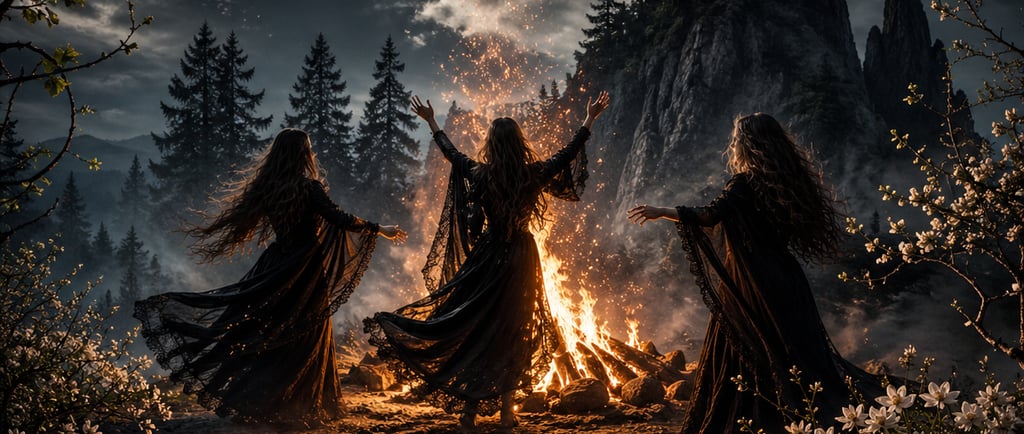
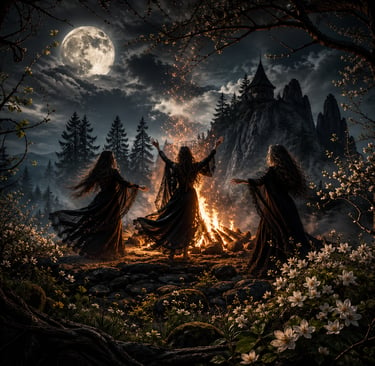
The air turns restless. The dark loosens its grip. Fires are lit. Masks appear. Old stories rise from mountain paths and village hearths. Witches gather in folklore, saints are remembered in churches, winter is driven out, and the green world begins to breathe again.
This night is known as Hexenacht, or more traditionally in German, Hexennacht, meaning Witches’ Night.
It is most closely tied to Walpurgisnacht, the night of April 30 into May 1. In German and Central European folklore, this is the night when witches were believed to fly to the mountains, especially the Brocken in Germany’s Harz Mountains, to gather, dance, feast, and meet with spirits or devils before the arrival of May.
But Hexenacht is not simply “an ancient witch holiday,” despite what modern occult aesthetics may suggest. Its history is stranger, richer, and more layered than that. It is part saint’s feast, part folk protection rite, part spring fire festival, part witch-trial fear, part Romantic literary dream, and part modern reclamation of the witch.
To understand Hexenacht, we have to step into the smoke.
What Does Hexenacht Mean?
Hexenacht means Witches’ Night.
In German, the more standard spelling is often Hexennacht, with two n’s, but English-speaking occult and Pagan communities frequently use Hexenacht.
The name is closely connected to Walpurgisnacht, or Saint Walburga’s Night, which falls on the eve of May Day. Over time, these names became tangled together. Walpurgisnacht is the older and more widely recognized cultural term. Hexenacht emphasizes the witchcraft and folklore side of the night.
You may see this night called by several names across Europe. Hexenacht or Hexennacht means Witches’ Night, while Walpurgisnacht means Saint Walburga’s Night. It is also known more broadly as May Eve, the night before May Day. In Germany, modern celebrations are sometimes called Tanz in den Mai, meaning “Dance into May.” Related traditions include Valborg, the Swedish Walpurgis celebration, Vappu, the Finnish May Day celebration, and Čarodějnice, the Czech “Witches’ Night” or “Burning of the Witches.”
At its heart, Hexenacht is a threshold night. It stands at the doorway between April and May, between winter and summer, between fear and fertility, between what must be burned away and what is ready to bloom.
Where Does Hexenacht Come From?
Hexenacht hails primarily from German-speaking Central Europe, especially the folklore of Walpurgisnacht.
Its most famous spiritual and folkloric landscape is the Brocken, the highest peak in the Harz Mountains of Germany. In German folklore, the Brocken was believed to be a gathering place for witches. On Walpurgisnacht, they were said to fly there on broomsticks, animals, or other strange vehicles to hold a great nocturnal assembly.
But this image did not appear fully formed in ancient times. Like many powerful folk traditions, it developed over centuries.
Hexenacht carries several historical layers:
Older May Eve and springtime customs
The Christian feast of Saint Walburga
Agrarian protection rites for homes, fields, and livestock
Early modern witchcraft fears
Folklore of the Brocken and the witches’ sabbath
Romantic literature, especially Goethe’s Faust
Modern Pagan, witchcraft, Satanic, and festival reinterpretations
That is what makes Hexenacht so fascinating. It is not one tradition preserved in amber. It is a living crossroads.
Saint Walburga: The Saint Behind Walpurgisnacht
The name Walpurgisnacht comes from Saint Walburga, also known as Walpurga or Walpurgis.
She was an Anglo-Saxon Christian missionary and abbess, born around the early eighth century, likely in Wessex, England. She became associated with the Christianization of parts of Germany through her family’s missionary work.
Here is the important part: Saint Walburga herself was not originally a witch figure.
Her life was Christian, monastic, and missionary. Her later connection to witches came about through timing, folk belief, and the merging of Christian feast days with seasonal customs already associated with May Eve.
May 1 became associated with her feast after the transfer of her relics to Eichstätt in Germany. Her shrine became known for healing traditions, including the famous oil of Saint Walburga, collected at her tomb and distributed to pilgrims.
So Hexenacht is not simply a Pagan versus Christian conflict. It is more complicated than that.
It is a night where Christian sainthood, folk protection, seasonal magic, and witch lore all overlap. Saint Walburga became a protective figure placed at the edge of a night already believed to be spiritually dangerous.
The Older Seasonal Layer: May Eve and the Turning of the Year
Long before modern Halloween aesthetics and witch hats entered the picture, the night before May Day was already powerful.
May Day marked the opening of the warmer half of the year in much of Europe. It was associated with greenery, fertility, flowering, livestock, outdoor life, and communal celebration. In many places, animals were moved out to summer pastures around this time. That made the season both hopeful and vulnerable.
When livestock left the safety of the barn, people worried about predators, disease, bad weather, theft, spirits, and harmful magic.
So communities lit fires.
They made noise.
They used protective plants.
They guarded thresholds.
They watched the night.
Bonfires were not only festive. They were protective. Fire drove away danger, purified the land, and marked the community’s will to survive the turning of the year.
This is one of the oldest-feeling truths of Hexenacht: fire at the threshold.
The fire says:
Winter is finished.
The old fear is burned.
The land is waking.
The people are watching.
The dark does not own us.
Witches, Fear, and Protection
Today, many of us hear “Witches’ Night” and think of empowerment, magic, ritual, sensuality, and freedom.
Historically, though, the association with witches was often rooted in fear.
During the early modern period, when witch trials and witchcraft accusations spread through parts of Europe, Walpurgisnacht became one of the nights when witches were believed to be especially active. People imagined witches gathering, flying, cursing crops, harming livestock, spoiling milk, raising storms, or making pacts with the Devil.
Protective customs developed around that fear. People used bells, whips, loud noises, fires, crosses, herbs, prayers, and charms to keep witches and harmful spirits away.
This is where modern witches need to be honest with the history.
Hexenacht was not always a night celebrating witches. In many communities, it was a night protecting against witches.
That does not make modern witch-positive celebrations invalid. It makes them more powerful if we are willing to hold the whole story.
The witch of Hexenacht has been feared, hunted, demonized, mocked, romanticized, commercialized, and finally reclaimed.
That is a lot of ash to rise from.
The Brocken: Mountain of Witches
No place is more closely tied to Hexenacht than the Brocken, the highest peak of the Harz Mountains.
The Brocken has long had an eerie reputation. It is often misty, cold, and atmospheric. It produces strange optical effects, including the famous “Brocken specter,” where a person’s shadow appears magnified on clouds or fog. It is not hard to understand why people imagined supernatural gatherings there.
By the seventeenth century, writers helped fix the image of witches gathering on the Brocken or Blocksberg. Later, Goethe immortalized this vision in Faust, where Faust and Mephistopheles encounter the wild and uncanny Walpurgis Night gathering.
From there, the Brocken became not just a mountain, but a mythic stage.
Witches flew there. Devils danced there. The ordinary world cracked open there.
The mountain became a symbol of everything civilization feared and secretly desired: wildness, power, sexuality, darkness, chaos, freedom, and contact with forbidden forces.
Goethe, Romanticism, and the Witch as Symbol
The Romantic period transformed Hexenacht.
Witches were no longer only legal threats or village nightmares. They became literary figures. Artists and writers used them to explore the irrational, the erotic, the wild, the rebellious, and the sublime.
Goethe’s Faust gave Walpurgisnacht a lasting place in European imagination. The witch gathering became a carnival of spirits, bodies, temptations, masks, and revelations.
This is part of why Hexenacht still feels theatrical today. It is not just a folk observance. It is a stage where the shadow performs.
And in the modern magical imagination, that matters.
Hexenacht asks:
What have you exiled from yourself?
What part of you was called dangerous because it was powerful?
What old fear is ready to become fire?
What mask do you wear, and what truth dances beneath it?
Why Is Hexenacht Celebrated?
Hexenacht has been celebrated, observed, feared, or reclaimed for several reasons.
To Protect the Home and Community
Historically, people observed the night to guard against harmful forces. Fires, noise, prayers, herbs, and charms were used to protect homes, animals, crops, and children.
To Welcome May
Hexenacht is the doorway to May Day. It celebrates the return of warmth, flowers, fertility, and outdoor life. Modern German celebrations often include dancing, drinking, music, bonfires, and costumes.
To Drive Out Winter
The bonfires of Walpurgisnacht are often understood as a symbolic burning away of winter, stagnation, illness, and misfortune.
To Honor Saint Walburga
In Christian tradition, the night leads into the feast of Saint Walburga, a saint associated with healing and protection.
To Reclaim the Witch
For modern witches, Pagans, occultists, and magical practitioners, Hexenacht has become a night of reclamation. The witch is no longer the village nightmare. She is the wise one, the outcast, the healer, the poisoner, and the medicine-maker, the woman at the edge of town, the one who knows what others forgot.
To Remember the Persecuted
Some modern groups, including Satanic communities, observe Hexenacht as a remembrance of those harmed by superstition, religious persecution, and witch hunts. This gives the night a solemn ethical dimension as well as a magical one.
What Does Hexenacht Represent?
Hexenacht represents many things at once.
It is a night of thresholds.
It is the edge between April and May, between winter and summer, between fear and fertility, between death and blooming, between protection and liberation.
In older folk culture, it represented danger.
In agrarian life, it represented the vulnerability of the seasonal shift.
In Christian practice, it belonged to Saint Walburga and healing protection.
In witch-trial culture, it became associated with supernatural threat.
In Romantic literature, it became a theatre of wildness and shadow.
In modern witchcraft, it has become a night of power, fire, reclamation, and renewal.
This is why Hexenacht still speaks.
It is not clean. It is not sanitized. It is not one neat thing.
It is a night of contradiction, and that is exactly why it belongs to the witch.
Modern Hexenacht Celebrations
Today, Hexenacht and Walpurgisnacht are celebrated in different ways across Europe and beyond.
Germany and the Harz Mountains
The Harz region remains the most famous center of modern Walpurgisnacht celebrations. Towns near the Brocken host festivals with witch costumes, devil masks, bonfires, music, medieval markets, performances, and crowds of visitors.
What was once feared has become a spectacle. The witches return, but now people dress as them on purpose.
Dance Into May
In many parts of Germany, the night is celebrated as Tanz in den Mai, or “Dance into May.” This is less about witchcraft and more about social festivity, music, drinking, dancing, and welcoming spring.
Czech Witch-Burning Customs
In the Czech Republic, April 30 is often associated with Čarodějnice, sometimes translated as “Burning of the Witches.” Bonfires are lit, and witch effigies may be burned to symbolize the destruction of winter, evil, or misfortune.
Nordic Walpurgis Traditions
In Sweden, Valborg is celebrated with bonfires, songs, and spring speeches. In Finland, Vappu has become a major civic and student holiday with carnival-like energy. These traditions share the May Eve fire and springtime threshold, even when the witch imagery is less central.
Modern Witchcraft and Pagan Practice
Modern witches may observe Hexenacht with:
Bonfires or candle rituals
Protection spells
Banishing work
Shadow work
Fertility and creativity rites
Ancestor remembrance
Offerings to land spirits
Dance, drums, chanting, and ecstatic movement
Beltane preparation
Reclaiming the witch wound
Honoring those persecuted as witches
For many practitioners, Hexenacht is paired with Beltane. Where Beltane celebrates union, fertility, sensuality, and blooming life, Hexenacht can serve as the night before the bloom, the burning away, the wild gathering, the shadow-clearing before the green door opens.
Hexenacht Journal Prompts
Use these on April 30, or anytime you are standing at a threshold in your life.
What part of me has been called dangerous because it was powerful?
What fear am I ready to burn away before May begins?
Where do I need stronger spiritual protection?
What old identity am I no longer willing to perform?
What does my inner witch want me to remember?
What am I ready to reclaim?
What part of winter still lives in me, and what does it need before it can leave?
What would I do if I trusted my own fire?
The Truth of Hexenacht
Hexenacht is often dressed in spectacle, witches on broomsticks, devils on mountains, fires in the dark, masks in the street.
But beneath the costume is something older and more human.
The fear of winter.
The hope of spring.
The need to protect what we love.
The danger of being different.
The power of becoming what once frightened others.
The fire that says, “I survived.”
Hexenacht is not just the night when the witches gather.
It is the night the witch is remembered.
The night the village fear becomes the witch’s freedom.
The night before May opens her green mouth and calls everything living back into bloom.