
The Enduring Echoes of Salem, Legends, Myth, and the Folklore That Still Haunts Us
A haunting exploration of the Salem Witch Trials, this post traces the line between documented history and enduring legend. From Puritan fear and spectral evidence to ghost stories, curses, and modern mythmaking, it examines why Salem still echoes so powerfully through the collective imagination.
LEGENDS, MYTHS, AND FOLKLOREHISTORY
FyreWytche
4/24/20266 min read
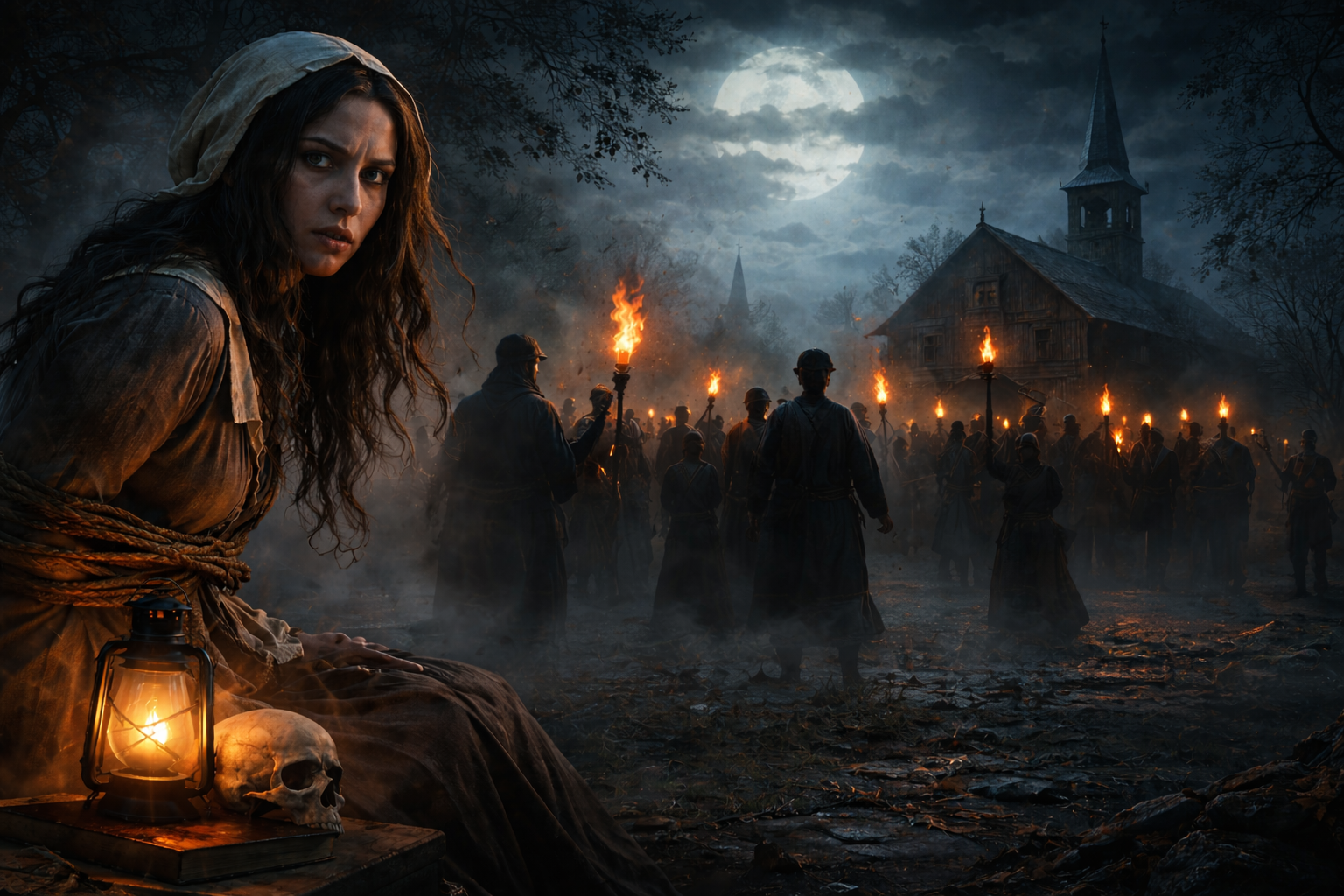
There are some moments in history that never truly loosen their grip on the collective spirit, and the Salem Witch Trials are one of them.
More than three centuries later, Salem still lingers in the imagination like smoke after ritual fire, half history, half warning, half ghost story whispered from one generation to the next. What happened there was not simply a series of accusations. It was a storm of fear, power, superstition, suspicion, and spiritual panic that consumed a community from the inside out.
Between 1692 and 1693, more than 200 people were accused of witchcraft in colonial Massachusetts. Thirty were found guilty. Nineteen were executed by hanging, and Giles Corey was pressed to death beneath heavy stones. Others died in prison, waiting for trials or mercy that never came. It was a brutal unraveling of reason, compassion, and justice.
And yet Salem did not remain only a place of documented tragedy. Over time, it became something larger in the cultural imagination, a crossroads where fact and folklore blur together. The historical record tells one story. The legends, ghost tales, and popular retellings tell a different story. Somewhere between them lives the Salem that still fascinates us today.
A fear already waiting to happen
The Salem Witch Trials did not appear out of nowhere. They rose from the soil of a rigid Puritan worldview, where the Devil was believed to be very real, always near, and actively seeking entry into daily life.
In that world, misfortune was rarely seen as random. A failed crop, a lingering illness, livestock dying, strange dreams, or unexplained pain could all be interpreted as signs of spiritual warfare. If suffering could not be explained by God’s will, it was often blamed on Satan, and by extension, on a human agent believed to be working in league with him.
This way of thinking made accusations dangerously easy.
The Puritans believed witches made pacts with the Devil. They believed in familiars, spectral attacks, witch marks, and other signs that would now be recognized as superstition, paranoia, or deeply flawed interpretation. Even more troubling, these beliefs were woven directly into the legal process. Witchcraft was not only feared as a spiritual threat, but it was also prosecuted as a felony.
That meant theology, fear, and law became entangled.
The perilous line between folk practice and “witchcraft”
At the same time, colonial life was full of folk customs, protective charms, divination practices, and healing traditions carried over from Europe. People used practical magic in quiet, everyday ways. They told fortunes, used sympathetic remedies, hung protective objects in their homes, and turned to superstitions for comfort, clarity, and control.
That contradiction matters.
Because while folk magic was quietly woven into daily life, it could also become incriminating when fear took hold. A remedy that looked helpful one week could be recast as sinister the next. A woman known for healing could suddenly be viewed as dangerous. A person already disliked, poor, outspoken, socially vulnerable, or somehow “other” could become the perfect vessel for collective dread.
Salem was not only about belief in the supernatural. It was about who got to define what kind of spiritual practice was acceptable, and who paid the price when those boundaries turned violent.
The danger of spectral evidence
One of the most disturbing features of the trials was the acceptance of spectral evidence, testimony from people who claimed the spirit or apparition of the accused had harmed them.
Think about that for a moment.
Someone could say your invisible form appeared to them, pinched them, tormented them, or haunted them, and that could be treated as evidence in court.
The afflicted girls’ fits, screams, contortions, and visions were interpreted as proof of witchcraft. Their performances in court, often public and dramatic, reinforced the panic. Once that kind of evidence was accepted, the system fed itself. Fear became proof. Performance became testimony. Suspicion became guilt.
It was only when prominent voices began to challenge the use of spectral evidence that the trials began to collapse. Once the courts could no longer rely on invisible accusations, the machinery of hysteria finally started to fail.
The myths that refuse to die
Salem’s afterlife in popular culture has given rise to countless misconceptions, some so widely repeated that many people accept them as truth.
One of the most persistent myths is that witches in Salem were burned at the stake. They were not. The executed were hanged, with Giles Corey dying by pressing. The image of burning comes more from European witch hunts and later cultural imagination than from Salem itself.
Another common myth is that only women were accused. Women were certainly targeted in greater numbers, and misogyny absolutely shaped the trials, but men were accused and executed, too.
There is also ongoing confusion around Tituba, one of the first accused. Popular culture often misrepresents her identity, but the historical record points to her being a Native American woman, likely of Arawak origin, enslaved in the Parris household.
And then there is the temptation to explain the entire crisis away with one neat answer, especially the ergot theory, the idea that moldy rye caused hallucinations and sparked the hysteria. While compelling on the surface, historians have largely rejected that as a complete explanation. Salem was not caused by one contaminated crop. It was the product of many forces colliding at once: religious extremism, legal failure, political instability, social resentment, economic pressure, war anxiety, personal grudges, and a community already primed for fear.
History is rarely as tidy as we want it to be.
The legends that rose from the gallows
If history gives us Salem’s facts, folklore gives us Salem’s shadows.
Few figures embody that shadow more than Giles Corey. Refusing to enter a plea, he was pressed to death beneath stones in an effort to force a response from him. According to legend, his last words were “more weight,” though other tales say he cursed Salem and its officials with his dying breath.
From there, folklore took over.
Stories spread that Giles Corey’s curse haunted the sheriffs of Essex County for centuries, bringing them illness, downfall, or early death. Others say his ghost appears before great disasters in Salem, a spectral warning that something terrible is coming. Whether historically verifiable or not, these stories function as a kind of folk justice. They give the wronged a voice beyond death. They refuse to let the cruelty of the trials disappear quietly.
Sarah Good carries a similar legend. Said to have cursed Reverend Nicholas Noyes from the gallows, she allegedly told him that if he took her life, God would give him blood to drink. Later stories claim he died from a hemorrhage, seen by many as the fulfillment of her final prophecy.
These stories endure because they restore something history cannot. They offer symbolic reckoning. They speak to a human need to believe that injustice leaves a mark, and that the dead do not always go silently.
Haunted Salem, memory wrapped in tourism
Modern Salem is full of this layered tension. It is part memorial, part marketplace, part pilgrimage site, part performance.
Places like Gallows Hill, Proctor’s Ledge, the Old Burying Point Cemetery, and the Witch House are surrounded by stories of apparitions, whispers, strange lights, and lingering spirits. Ghost tours, haunted happenings, museums, shops, and witch-themed experiences now shape much of the city’s identity.
There is something deeply complicated about that.
On one hand, Salem’s tourism keeps public attention fixed on a history that might otherwise fade. On the other hand, it risks turning suffering into spectacle. The city has, in many ways, commercialized its own trauma. That does not make the fascination meaningless, but it does ask something of us as visitors, readers, and seekers. We must remember that behind every ghost story is a real human life. Behind every myth is a record of fear weaponized against the vulnerable.
Salem in the cultural imagination
So much of what people think they know about Salem comes not from historical documents, but from stories retold through literature, film, and television.
Arthur Miller’s The Crucible shaped modern understanding of the trials more than perhaps any other work, even while changing key facts for dramatic and political effect. It turned Salem into a powerful allegory for McCarthyism and mass accusation, but in doing so, it also blurred history for generations of readers and audiences.
Then came Bewitched, Hocus Pocus, and other retellings that softened, stylized, romanticized, or reimagined the figure of the witch entirely.
That shift matters.
The Puritan image of a witch was rooted in terror, sin, inversion, and allegiance to the Devil. The modern image is often one of intuition, power, healing, rebellion, mystery, and feminine agency. The witch has culturally shifted from a symbol of corruption to one of reclamation.
That transformation says as much about us as it does about Salem.
Why Salem still calls to us
The Salem Witch Trials endure not only because they were horrifying, but because they remain painfully recognizable.
They remind us what happens when fear outruns truth.
When authority is left unchecked.
When rumor becomes evidence.
When difference becomes danger.
When a community, desperate for order, chooses scapegoats instead of self-examination.
Salem lives on because it is not just history. It is a mirror.
Its legends, curses, ghost stories, and distortions reveal how people process trauma through story. Its myths show how easily collective memory bends toward drama. Its facts still warn us that justice can collapse when fear is given the microphone.
And perhaps that is why Salem still hums so loudly in the cultural imagination. Not because it is safely buried in the past, but because its echoes still move through the present.
In Salem, history and folklore walk hand in hand. One tells us what happened. The other tells us what we still fear.