
The Hat Man of Shasta Lake: A Universal Entity in a Paranormal Hotspot
Dive into the global urban legend of the Hat Man, a shadowy, silent figure terrifying people worldwide. We'll explore his consistent, chilling characteristics and the various theories behind his existence, from sleep paralysis and chemical influence to supernatural origins. While the Hat Man is not a legend unique to Shasta Lake, we examine how this unsettling phenomenon might find a home in one of the world's most paranormally active regions, blending universal fear with a local landscape of ancient lore, cryptids, and UFOs.
LEGENDS, MYTHS, AND FOLKLORE
Jackie Taylor
10/4/20255 min read
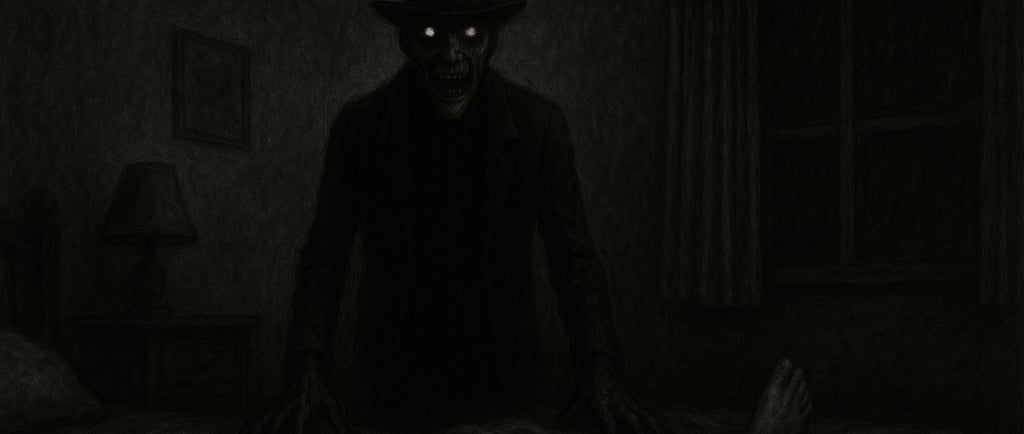
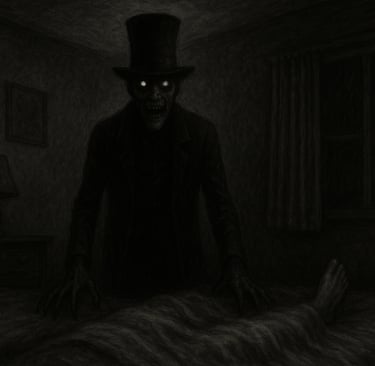
The Hat Man: A Global Enigma within the Lore of Shasta Lake
The Hat Man is a pervasive and unsettling figure in urban legend, terrifying people across various cultures worldwide. His characteristics are remarkably consistent across continents, suggesting a universal archetype rather than a localized myth. This blog examines the Hat Man phenomenon, detailing its universal characteristics and exploring how reported sightings may fit within the broader paranormal landscape of Mount Shasta and its surrounding lake. It is crucial to note that the Hat Man is a global phenomenon, not a legend unique to the Shasta region, a distinction underscored by the absence of specific, indigenous Hat Man lore tied directly to Shasta Lake. The Hat Man’s presence is not of Shasta Lake in the same way that the Klamath spirit Skell is of Mount Shasta, but rather a universal phenomenon that could manifest in such a paranormally active area.
Anatomy of a Nightmare: The Hat Man's Appearance and Behavior
The Hat Man is consistently described with a set of distinct characteristics that contribute to his terrifying presence. He is universally depicted as a very tall, shadowy entity, typically ranging from 6 to 10 feet in height, often causing him to appear hunched or crouched over. Unlike more ethereal shadow people, the Hat Man has a solid, well-defined outline, even though his features remain dark and indistinct. Witnesses often report that the figure is ill-defined and hard to focus on, appearing as a “living shadow” that sometimes flickers or fades. A particularly eerie detail is the observation that even under bright light, the Hat Man does not become illuminated, almost as if he is “actually made of shadow”.
His attire is his most defining visual element: a black brimmed hat and a long coat or cape. The style of the hat varies, with common reports mentioning a top hat, fedora, southwestern cowboy hat, or even a gaucho hat. The coat is frequently described as a trench coat, duster, or cloak, sometimes resembling “old-timey clothes”. Facial features are generally absent, with witnesses describing a “featureless, dark face”. However, a chilling and frequently reported detail is the unsettling “knowledge” that the figure is smiling, despite no visible mouth or facial contours. Less common reports include glowing red eyes or the presence of a gold pocket watch.
The Hat Man typically appears silently and exclusively in “pitch black” conditions. Most encounters occur when individuals are in a transitional state of sleep, such as falling asleep, already asleep, or waking up. The primary behavior attributed to the Hat Man is one of silent observation, standing still in the same place for a while, and silently observing people. The figure is often seen at a distance, such as in the corner of a dark room or just outside a bedroom door. Despite his often passive actions, the Hat Man’s presence is almost universally described as “incredibly scary, ominous, and dark”. A prominent theory suggests that the Hat Man deliberately cultivates this atmosphere of fear because he “feeds off of the strong energy of distress”. When the Hat Man departs, he is reported to do so by “using the door and either walking or gliding through it,” a notable contrast to other shadow entities that might simply dissipate.
Unraveling the Mystery: Theories and Explanations
The nature of the Hat Man is subject to intense debate, with theories spanning from the purely paranormal to the scientifically explainable.
Paranormal and Supernatural Interpretations
Many who encounter the Hat Man believe him to be a genuine supernatural entity. A common classification places him as a distinct form of a “shadow person,” a broader category of dark, humanoid figures. Some propose he is an “interdimensional entity” or an “evil soul wrangler” that collects lost spirits. Paranormal expert Rosemary Ellen Guiley has speculated that the Hat Man and other shadow people might be “shape-shifted forms taken by Djinn,” referencing the genies of Arabian mythology. Other interpretations categorize the Hat Man as an “evil spirit,” a “sleep paralysis demon,” or even “the Devil himself”. A less common theory among ufologists suggests that the Hat Man could represent an “alien species observing people”.
Scientific and Psychological Perspectives
The most prevalent scientific explanation for Hat Man sightings is that they are directly linked to episodes of sleep paralysis (SP). Sleep paralysis occurs when the brain awakens but the body remains in the temporary paralysis of REM sleep, leading to vivid, often terrifying, hallucinations. The Hat Man’s typical non-physical interaction aligns precisely with the physical immobility experienced during SP. These hallucinations are specifically categorized as hypnagogic (occurring as one falls asleep) or hypnopompic (occurring as one wakes up). The remarkable consistency of the Hat Man’s description suggests he might represent a “universal fear or archetype” within the human psyche. Cultural storytelling and the widespread sharing of these experiences through online forums can significantly amplify this phenomenon.
Beyond natural physiological states, some reports link Hat Man sightings to chemical inducement. A significant number of accounts connect the appearance of the Hat Man to the consumption of medication containing diphenhydramine (DPH), the active ingredient in Benadryl. High doses of DPH are known to induce agitation, confusion, delirium, depression, drowsiness, hallucinations, and seizures, which could readily explain such visions. Similarly, some accounts connect Hat Man hallucinations to the use of Ayahuasca, a traditional ceremonial brew. The consistency of the Hat Man vision among Ayahuasca users further points to a specific neurological pathway or shared psychological response. Some reports also suggest that the Hat Man appears to individuals experiencing “major trauma” or intense negative emotions.
Shasta Lake: A Nexus of the Unexplained
Mount Shasta, located in Northern California, is widely recognized as a significant hub for diverse paranormal and esoteric phenomena, often described as “the most paranormal place on Earth”. This reputation makes it a natural point of inquiry for any discussion of unexplained phenomena, including the Hat Man. The region is steeped in a rich tapestry of ancient and indigenous lore, particularly from the Klamath, Karuk, Wintu, and Yana tribes. Beyond indigenous traditions, Mount Shasta has become a focal point for various non-Native American legends and New Age spiritual movements. A prominent belief centers on a hidden city called Telos, said to be inhabited by advanced beings from the lost continent of Lemuria. The mountain is also a hotspot for cryptids and unexplained phenomena. Sightings of Bigfoot have been reported in the area, and UFOs and strange lights are frequently observed. The sheer volume and diversity of these reported phenomena underscore Mount Shasta’s unique status as a magnet for anomalous claims.
Despite the focus on “The Hat Man of Shasta Lake lore,” the Hat Man is a global phenomenon primarily linked to sleep paralysis. While Mount Shasta is a nexus of mystery where any paranormal encounter might occur, the available documentation detailing Shasta’s specific lore does not mention the Hat Man as an indigenous or prominent figure within its unique folklore. Therefore, any connection between the Hat Man and Shasta Lake is inferential: if a global phenomenon occurs and Shasta is a paranormal hotspot, it is conceivable that sightings could happen there; however, the provided data does not offer unique Shasta-specific accounts of the Hat Man. The Hat Man’s lack of a specific origin story tied to Shasta Lake distinguishes him from indigenous legends, such as Skell and Llao, or the narratives of the Lemurians. However, his shadowy, potentially interdimensional nature aligns well with Shasta’s overall reputation as a magnet for the unexplained.